As the number of photos increases exponentially, I thought it was time to go back and pick out
some of my favourite photos and moments. Some are chosen because of what the situation reminded me of, others due to the playfulness of the birds in the photos. It was hard to choose just a few photos, and there are others I haven't posted here that I can recall without much effort but at some point I had to just go with what I have picked out. I have written a little piece about why these shots are the ones I've chosen. I have put a link to the original posts for each after the photo for each. I hope you enjoy.
Brown Falcon with a Centralian Blue-tongue
Definitely one of my all-time memorable moments bird-watching. I had stopped the car on a small track near Tilmouth Well, and noticed something moving on the ground not far from me. I had not stopped because I had seen the Brown Falcon, and couldn't quite believe my eyes when I realised that not only was there a beautiful bird of prey sitting on the ground very close to where I was standing, but it had a Centralian Blue-tongue lizard underneath it. I circled the bird for probably 5 minutes, and at one point it tried to fly off with its dinner, but the lizard was too heavy for the Brown Falcon to fly more than about 10 metres. Although I bird-watch a lot when I am driving, this little experience confirmed in my head that although we see lots of birds, there are so many other little activities we don't even realise is happening right next to where we drive past.
Variegated Fairy-wren feeding immature Horsfield's Bronze Cuckoo
At one point in my working life, not long after I bought my firt DSLR, I was walking around the Saltbush at work (Charles Darwin University in Alice Springs) and could hear a young bird demanding to be fed. I could hear a number of other bird species also, and then finally spotted this cuckoo sitting in amongst the branches. Happily clicking away as you do with a DSLR, the shots I was getting weren't the best, but at the time I thought they were fantastic - funny how experience teaches you those initial shots really weren't the best. As I was looking through some of the shots I had just taken, I noticed a little flash of colour zipping through the saltbush. I was concentrating more on the Cuckoo because it was the one making all the noise. At this point in time my birding experience was still naive, and couldn't believe what I saw next. Here was this little bird, the Variegated Fairy-wren, feeding this Cuckoo at least twice its size and obviously (to me) not one of its own young. Since this experience I have learnt this is quite common because Cuckoos lay their eggs in other birds nests and let the other species raise their young. I have also encountered Channel-billed Cuckoos being fed by Little Crows in Alice Springs.
The scene in the saltbush at work really was an exciting birding experience.
Budgerigars at Owen Springs Station Redbank Waterhole
In 2011 and 2012, Central Australia experienced rain events that I hadn't seen since arriving in the Centre in 2000. The birds bred ferociously and one of the species that gathered in huge numbers were the Budgerigars. As far as I know, it is only the green variety that is wild in Australia, and driving around the highways and roads around Alice Springs was quite dangerous for bird-watchers (and others on the road) due to the flocks that would suddenly burst from a tree beside the road as the car approached. (The danger was that your eyes weren't really on the road any more!) On one occasion in November last year (2012) I stayed overnight at one of the places that still had water left over from the rains. I had seen a few hundred Budgerigars in the late afternoon the night previous and hoped they would come back with a few of their friends in the morning for a drink. What happened still brings a smile to my face. Five thousand or more Budgerigars screeched, chatted, wheeled and drank right in front of me, chased by numerous birds of prey, so, nervous at the best of times they were constantly on the move. I was entertained for at least two hours by the huge flocks of budgerigars, something I will never forget.

White-bellied Sea-eagle with Catfish
One place I believe all bird-watchers in Australia should get to is Kakadu in the Northern Territory. There is a cruise on Yellow Waters at Cooinda in the middle of the National Park that really opens your eyes to the birdlife of the swampy areas of Kakadu. In 2011, my family and I visited for a couple of weeks, during which we went on the cruise. Not long after we had left the safety of the shores, we saw our first crocodile, and a myriad of birdlife. We turned a corner and the person in charge of the boat slowed down to drift slowly as we watched Whistling Ducks, Jabirus, Comb-crested Jacanas, Ibis, Egrets, Herons etc. etc. From our right came a White-bellied Sea-Eagle that flew along the banks and then swooped down and clutched at something. I was lucky to be on the correct side of the boat to be able to watch and click away with the camera. When the bird finally managed to extricate the prey from the water, I couldn't believe the size of its catch - a whopping Catfish. It then flew across the front of the boat and settled on its nest on an island to the left of the boat. It was about to tuck in to its dinner but was forced off its nest by two dive-bombing Masked Lapwings, so it couldn't even enjoy the fruits of its labour. A truly awesome experience to watch!

Australian Hobby
This was one of those rare occasions when you get a second chance to get a decent photograph. The Hobby had been sitting on the branch that you can see in the photo prior to this and my camera just couldn't focus. The Hobby flew off and I moved to a spot a few metres from where I was to try to get the camera to focus, and said aloud "could you please come and sit back on the branch". To my delight, the Australian Hobby did a loop of the nearby area and came back and settled on the exact branch I was hoping it would return to and I managed to capture this photo. A truly wonderful experience watching a very swift, graceful and colourful Bird of Prey.
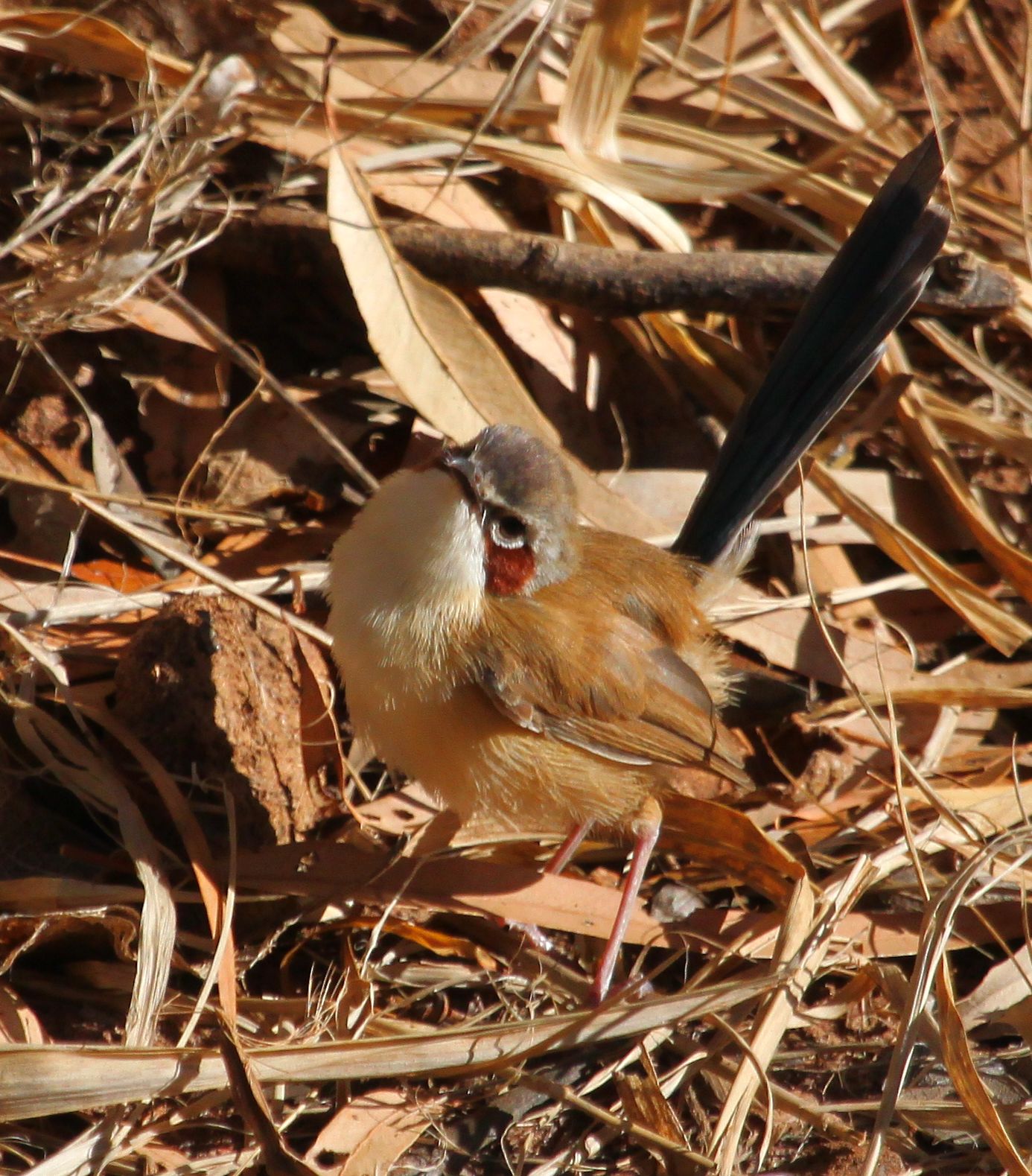
Purple-crowned Fairy-wren
I'm not sure how often this happens with other bird-watchers, but I have managed to dip on almost every bird I specifically try to see in a location that a bird has been reported by someone the previous day, or in the bird books the species "is always there" - except on the day I go! The Purple-crowned Fairy-wren was one species I felt sure I was going to see at the Victoria River Roadhouse, in the far north-west of the Northern Territory. Why? Because they are "always there in the grasses by the roadhouse". I searched in vain for these beautiful birds, and thought I had seen a pair that flitted from one side of the track down near the boat launching area, to the other. Dip! Again! After a couple of hours I gave up as "they don't normally come out in the middle of the day" according to another report I had read. I continued on my travels during that weekend and ended up at a river crossing at Camfield Station. I wasn't actually looking for the wren any more, but figured there would be some birding photo opportunities. I was so delighted to see the bird, I almost forgot to photograph it. I couldn't believe my eyes. Maybe not in full colour due to the time of the year, but still a special experience for me.

Red-capped Robin
Part of the joys of animals is that they are probably just as individual as people, some like to be quiet and reserved, whilst others like to be the life of the party. This Red-capped Robin was at Simpsons Gap, in the carpark just near the visitors area as you enter. It was flitting around catching insects on the ground and in the air, and seemed oblivious to my presence. It came to within a few metres of me several times, sitting on the wire fence surrounding the car park. I love the colourful birds, and have had a number of close encounter with Red-capped Robins, but this one in particular has a special memory for me because it really did prance around in front of me.
Spotted Harrier
This was one of the occasions where the late afternoon light probably made the occasion more special than other experiences with a Spotted Harrier. I love all raptor encounters, but this one was hunting low over pale yellow grasses in the late afternoon on the Barkly Highway near Avon Downs Station. As the light was fading, the bird flew low towards the setting sun. It eventually found something and I lost its location as it went down into the grasses.
Striated Pardalote
The final bird in this list of favourites is the Striated Pardalote I met at a place called Jasper Gorge. This is in the Victoria River District, or VRD in the Northern Territory. I spent the night in a small campground with one other group of people and saw many species of birds there, but this little bird was so friendly and inquisitive. It would fly off and then return, swoop around the tree it was perched originally and then return, and it would look at me often as if to say "Aren't I just the prettiest bird around here!" With its striking orange markings, and personality to match, I had to agree it was hard to take my eyes, and the camera lens, away from it.