Notes to readers of this Blog


NOTES TO READERS OF THIS BLOG

Thank you for dropping by to check out my blog. You will see a lot of other Blogs about birds I follow down the left hand side. I strongly encourage you to check some of these out as well, they are entertaining and I love to see birds from all over the world, I hope you do too.
Cheers,
Richard

Thursday, 31 March 2016

Pallid Cuckoos, Crested Bellbird, Red-tailed Black Cockatoos, Red-backed Kingfishers

Where to look? Up, down, left, right. Birds flying everywhere. Tiny birds, flocks of birds, birds of prey circling. Just when should you stop?

The above thoughts are typical in central Australia at the moment. Every time we think it is starting to become too dry, we receive another sprinkle from the sky above to freshen everything back up again, and from a "quieter" day the day before, suddenly the birds spring back into action with a deafening roar.

Recently I stopped at an old haunt, wondering if the surrounds were really as active as they sounded from the road. It was. An unbelievable variety and number of birds. Yes, there were extremely little birds, Thornbills, Fairy-wrens, and Southern Whiteface, yes there were mid-sized birds - Budgerigars, Cockatiels, Honeyeaters, Woodswallows, and larger birds - Pallid Cuckoos, birds of prey, Galahs and Red-tailed Cockatoos. I could see why some of the birds were around - the seeding grasses, but I think the rest of the birds were just being sociable, apart from the Pallid Cuckoos - they were just being plain noisy, young ones constantly begging. Throughout the cacophony of incessant noise came a peep from one of the alarmists. Every single bird went quiet within moments from the alarm call. I frantically searched above the trees and the skies, looking for the cause of the alarm. Normally when the danger was gone, the twittering in the trees start up again within a minute. The silence this time grew longer and longer. I looked at my watch. Two minutes, three minutes and then four. Something was definitely around scaring the voice out of all the other birds. Finally, after more than 4 minutes, one of the White-plumed Honeyeaters sang out, and soon the chorus began in earnest from everywhere. A frustration of birding is sometimes you don't find out what was the cause. This was one occasion.

Below are some shots from the area on this occasion.

Pallid Cuckoo


Red-backed Kingfisher

Crested Bellbird


Red-tailed Black Cockatoo


Tuesday, 29 March 2016

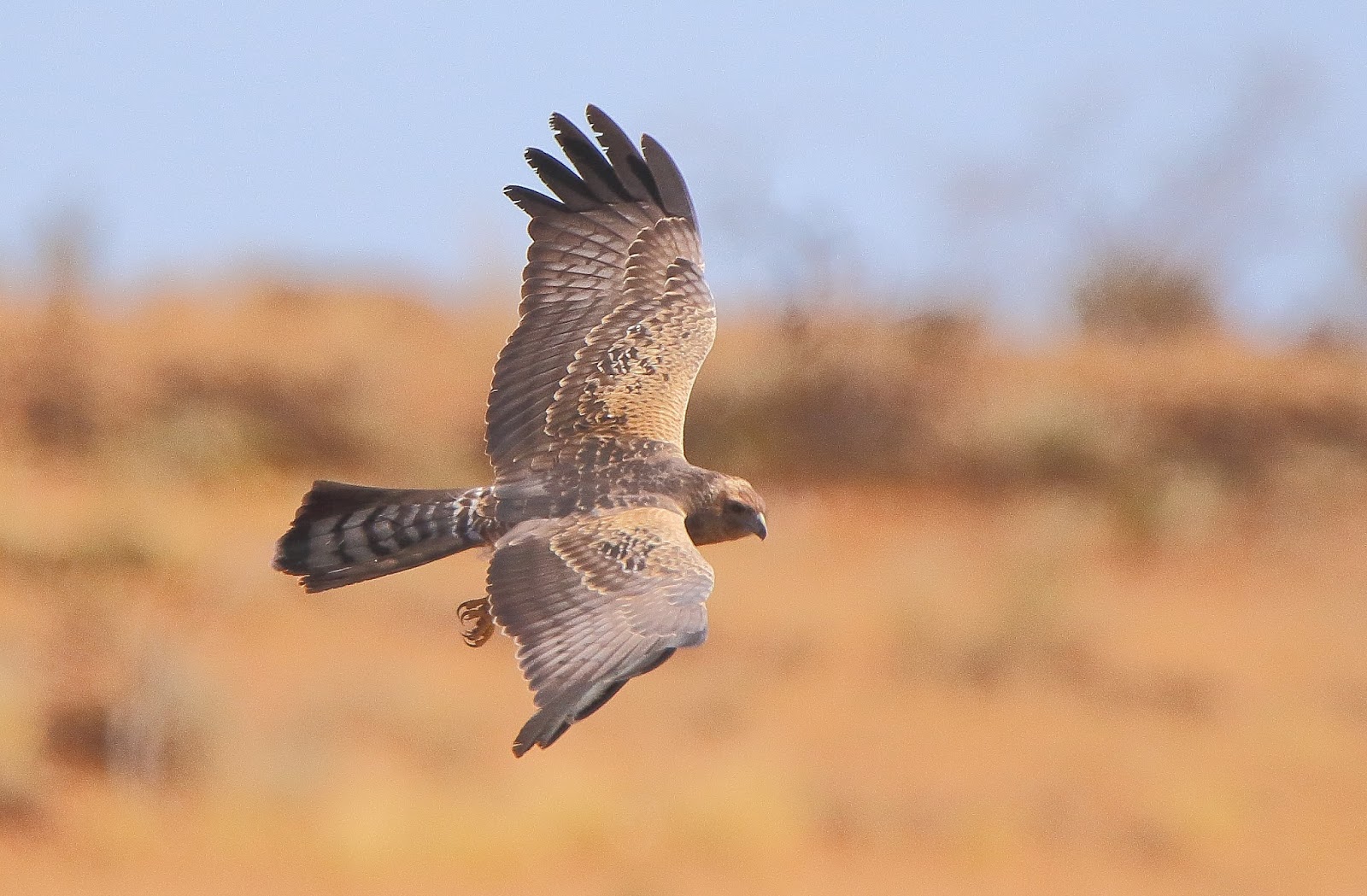
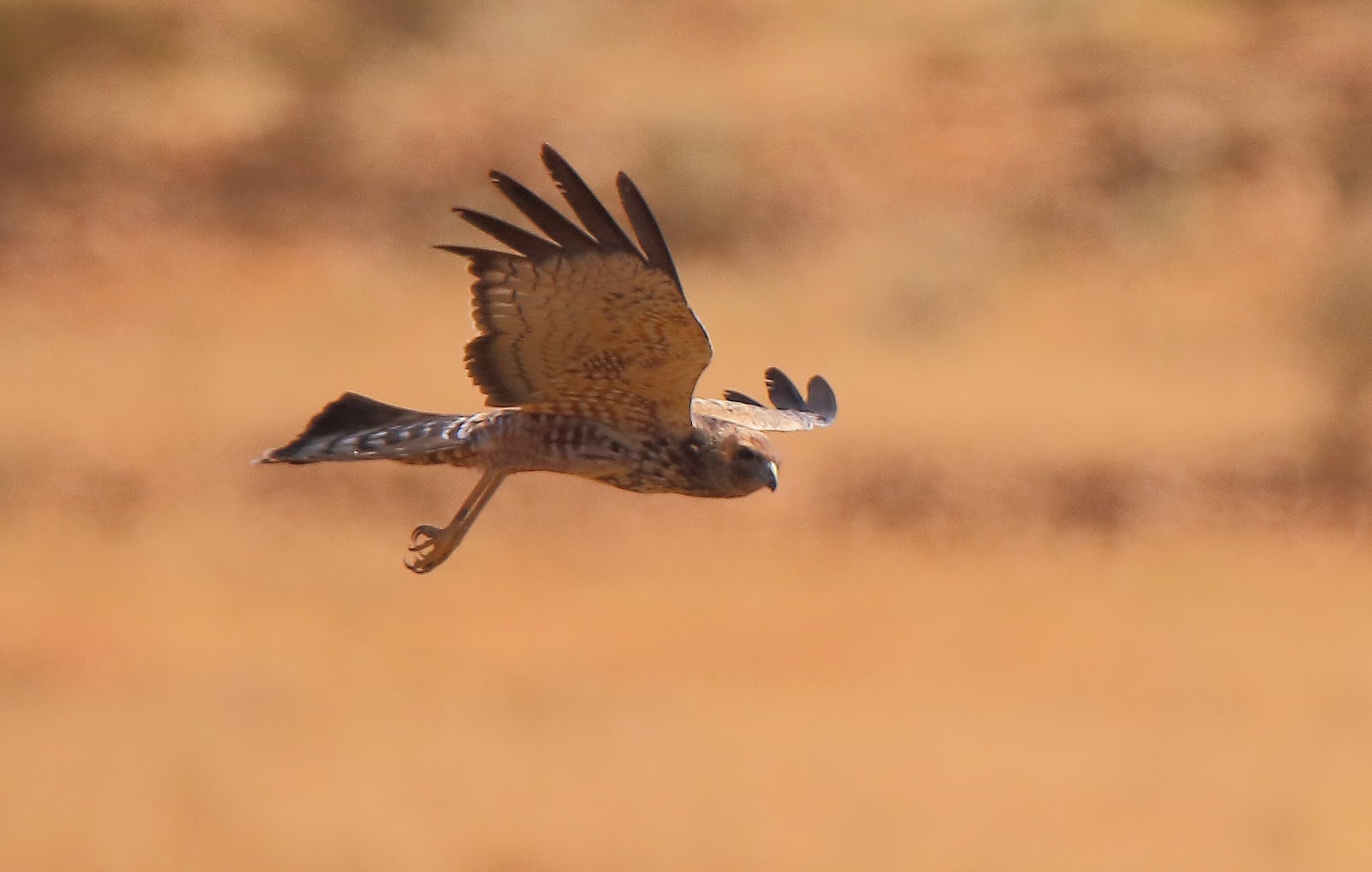
A Couple of "Juve's" - Spotted Harrier and Brown Goshawk

It is always exciting to see new life exploring the world. In the birding world, that can be a chick fledging from a nest or hollow, or starting their new life as a hunter, making mistake after mistake until they finally start to succeed more often.

I watched as a young Brown Goshawk flew in to a group of Zebra Finches on a leafless bush near a water hole time after time, failing to grab any of the fleeing Finches. It would then sit in the bush, seemingly confused why it wasn't munching on some tasty bird. A few times it would even get its wings caught in the twigs of the bush, before flapping off to a nearby perch. It swooped from 30 metres from the cover of a stand of trees across the dam to the water's edge, again without success. It would then perch under the large tree the finches and budgies were using as a launching pad to fly down for a drink, not a particularly inconspicuous place. Ultimately it decided to fly off and catch some of the larger grasshoppers around.

The Spotted Harrier then replaced the Goshawk, and the difference in the speed is marked. The Harrier looks like it had been chewing on the wrong sort of weed for the morning, slow, laboured wingbeats, skinny long legs, and even though it didn't seem to be hunting the same prey, looked as if it was a few months behind the Goshawk as far as life skills was concerned.

Both birds had the weird and almost spooky head turn of 360 degrees the lots of birds seem to have. But in flight and close-up, it would be appropriate in a horror film, like Linda Blair in the Exorcist, rather than the wonder of nature. Lucky it wasn't a cloudy day just before dusk!

These two young birds need to be one the lookout, as other birds of prey are in the same area. Over a few visits, I have seen Grey Falcon, Wedge-tailed Eagle, Little Eagle, Brown Falcon, Peregrine Falcon, Nankeen Kestrel, and both Whistling and Black Kites. The two Eagles would probably be the biggest threats to the two juveniles, especially if they managed to be eating some prey more to the Eagles' liking. So I was on the lookout myself for the other birds of prey after observing the constant head swivels. On this occasion, these were the only two in the immediate vicinity.

Birds of prey are definitely some of my favourite birds, probably because of their size and ease of narrowing down what type they are. And Spotted Harriers are always a delight to try to photograph, generally because of their relative slowness compared to some of the other birds of prey. Below are a few shots from my time with the "two Juve's".

Spotted Harrier


Brown Goshawk


Sunday, 27 March 2016

Wedge-tailed Eagles - the Royal Family of the birding world in the Centre

Wedge-tailed Eagles are so majestic. As the sun starts baking the earth in Central Australia, the roadkill becomes more prevalent, and so do the sightings of these magnificent birds.

Here are a few recent Wedge-tailed Eagle photos.


Wednesday, 23 March 2016

Wild Cockatiel family fun in the backyard

The Cockatiels are one of those birds that are easily identifiable by their calls. Recently they have returned to visiting my back yard, and occasionally I grab the camera and take a lot of photos, hoping to capture a few of those magical interactive moments as well as some "portrait" shots. The young ones are not as loud as some of their cousins in the parrot world when it comes to begging, but they still make a fair bit of noise. Generally I find Cockatiels to be very flighty out bush, but this family of 6, mum, dad and 4 juveniles, seemed fairly relaxed in the backyard. The first two photos are of the adult male telling the juveniles there is no room on his perch.

Cockatiels


Baby Budgies in the hollows

The creek and river beds around Central Australia are full of the begging sounds of Budgerigar chicks in the hollows of the River Red Gums. With plentiful food from the recent rains in easy reach for the parents, the sounds of new life can be deafening. The cacophony from the growing chicks drowns out even the Yellow-throated Miners, and that's no mean feat. Only when the alarm calls from the White-plumed Honeyeaters of an approaching threat causes a lull in the chirps from inside the trees.

The following is a series of photos I captured earlier this week. I got a nice surprise when I downloaded the photos and saw what was in the hollow in the second photo. Hope you enjoy.

Budgerigars


Monday, 21 March 2016

Painted Finch, Cockatiels, Yellow-rumped Thornbill and a couple of reptiles

The rains have disappeared at least for the moment and the countryside around Alice Springs is drying out. Puddles only last a day or two, and the birds need to find new water sources. I saw a group of about 1000 budgerigars heading west along the Macdonnell Ranges over the weekend.

I also saw a small group of Indian Ringneck Parakeets, not good for the local parrot populations. Hopefully the parakeets will be caught soon.

On the brighter side, there have been a few good photo opportunities recently, starting with this delightful Painted Finch who decided to land nearby as I was looking for a different bird. Always nice when these occasions happen along.

Painted Finch


Another delightful experience recently was a visit to the back yard gum tree by 4 Cockatiels, 2 males and 2 females. I feel very fortunate to have these lovely birds to watch without leaving home!

Cockatiels


Another nice and close encounter recently was a small group of Yellow-rumped Thornbills. Here was one that I managed to photograph without leaves or branches in the way.


And as the air and surrounds dry out, the reptiles seem to become more common, Below is a Long-tailed Dragon and a Sand Goanna.


Wednesday, 9 March 2016

A story and sequence of photos of a pair of Black-breasted Buzzards and Brown Falcon encounter

It is not unusual to see more than one bird of prey on the same day in my travels. What is unusual is to see two different types sitting very close to one another on the same branch.

I was driving along one of the outback roads west of Alice Springs and noticed a pair of Black-breasted Buzzards. The female flew off and the male obligingly stayed in the tree near the road. After a short time he followed to where the female had flown. I kept the camera trained on the male as it flew off, presumably to re-unite with its mate. As he moved further from me, I switched the focus to the tree where I thought he would land, next to the female. Instead I was in for a bit of a shock. There were already two large birds sitting there. I assumed the smaller of the two already on the branch was a juvenile Black-breasted Buzzard. I was wrong. Instead, a Brown Falcon was on the branch.
It was unfortunate the tree in question was so far away as some of the shots would have been much better, but the encounter was still interesting for two reasons.
Firstly, seeing the male and female BBBs together now, are they getting ready to breed? And secondly, was the Brown Falcon more aggressive as there was a nest nearby? Or was it just that the tree in question was the best vantage point for the local hunting ground. Regardless, I enjoyed the brief show.

Black-breasted Buzzards and Brown Falcon